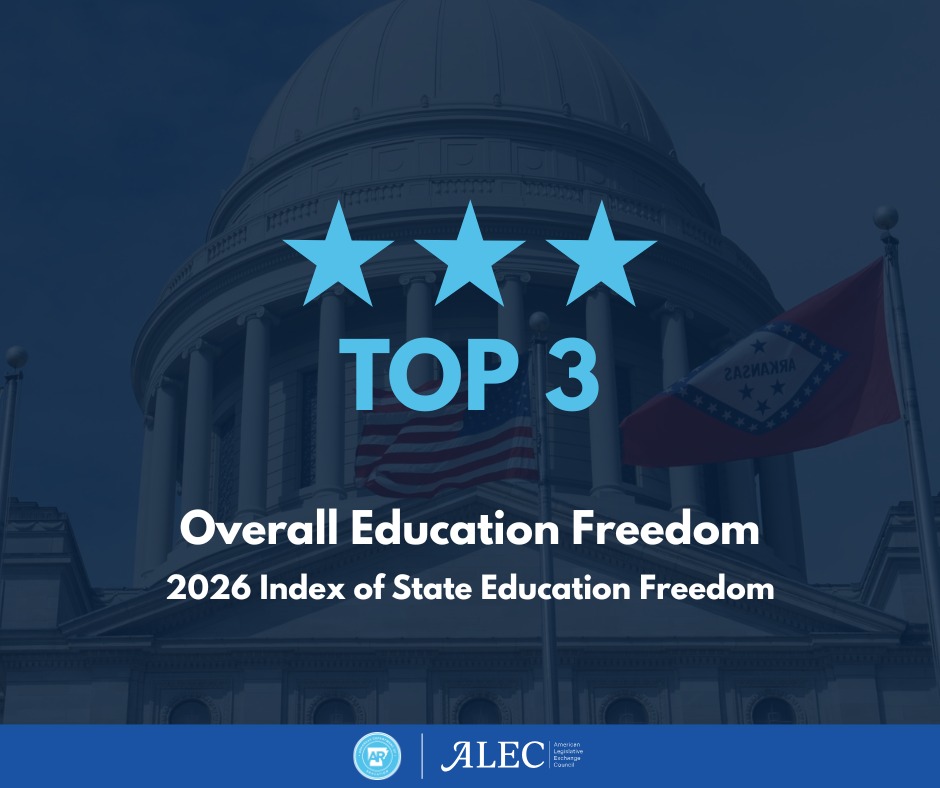
LITTLE ROCK, Ark. – For the second year in a row, Arkansas ranks in the top three states on the American Legislative Exchange Council’s (ALEC) Index of State Education Freedom. The report analyzes each state’s charter school, homeschool, virtual school and open enrollment laws to determine accessibility to a variety of learning environments. This recognition affirms Arkansas’ broad efforts to ensure families are empowered to make educational decisions that best meet their child’s individual needs. Additionally, Arkansas ranks first in accessibility to virtual school options.
“It’s clear that Arkansas is making rapid progress to ensure every child, no matter their ZIP code, has access to high-quality learning environments,” said Secretary of Education Jacob Oliva. “With more than 44,000 families taking advantage of Education Freedom Accounts, it’s evident that the power to choose is valued in Arkansas. This report confirms that the path we’ve been on since the passage of LEARNS is moving in the right direction to improve educational outcomes and be recognized as the top state for education.”
“I made education my administration's top priority because I know firsthand how much the right learning environment matters for a student's growth,” said Governor Sanders. “Arkansas has made incredible progress in expanding opportunity and empowering families to choose the education pathway that works best for their child, and I’m excited by the results we’re seeing.”
Governor Sanders signed Arkansas LEARNS into law in 2023, establishing the Education Freedom Account (EFA) program, among several other initiatives. Through EFAs, families in Arkansas seeking to enroll their children in private, parochial or homeschool settings can receive financial assistance. During its pilot year, the Arkansas Department of Education issued EFAs to more than 44,000 families.
Because of its success with EFAs, Arkansas received an “A” letter grade in the category of Student Centered Funding Programs. Arkansas also earned an “A” in Virtual Schooling and Open Enrollment, highlighting the state’s continued commitment to meeting the diverse needs of every student.
The full ALEC report can be found here.