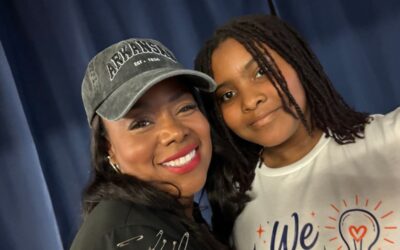
When Shia Taylor discusses education, especially her own education history, she lights up in a way that fills the room with joy.
“My schooling journey was really interesting. I look back at it now, and I’m like, what? It was kind of like a roller coaster. But, you know, at the end, after you scream and everything, you’re like, I can do that again,” she said with an infectious laugh. “I had multiple schools I went to until middle school. I thought it was private school. I didn’t know until I graduated that I was actually a homeschool kid who was in a co-op.”
The confusion stemmed from a Monday-to-Friday schedule, different teachers in each subject, all just like a “normal” school. In hindsight, though, there were clues.
“It wasn’t like a regular school for our athletics. Our athletics list was, like, bowling and ice skating. I never saw that in public school!” she recalls, again with a laugh.
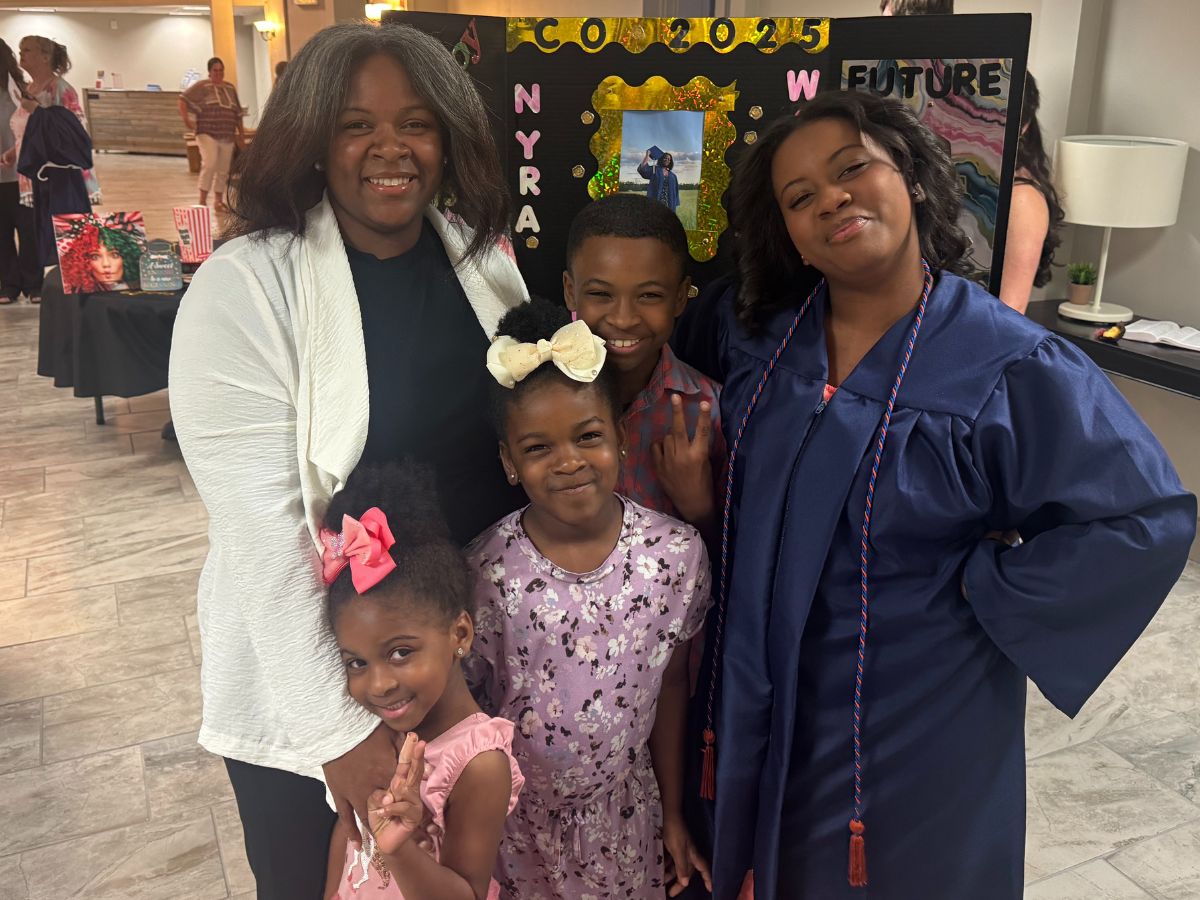
Nowadays, though, Taylor is a mother of five making education decisions for her own school-age children. And there have been many decisions.
“When I first started the journey, I was a single mom making very little money, and I just didn’t know how to make it work,” she explains.
Nevertheless, a bad experience in a public school for her eldest led to her enrollment in a homeschool co-op, like mom, and making financial sacrifices where needed. She succeeded and has since graduated. But the younger siblings – with the second child nine years behind the oldest and two more each two years apart – are now in Foundation Christian Microschool in Little Rock. Her youngest, a newborn, isn’t quite there yet.
 “I became aware of the microschool aspect of education when my oldest daughter was little,” she said. “So I knew the microschool option was there, and I would have loved to explore it deeper, but it didn’t meet our needs at the time. I needed something that was, for me, a bit more cost-effective, and back then they weren’t.”
That’s changed in time with more microschools, in no small part thanks to a move to Arkansas, where the Education Freedom Account (EFA) program provides financial support to families who choose homeschool or microschool.
“When I got to Arkansas, I had never had financial support before. It was all out of pocket,” she said. “Coming to Arkansas, my world of possibilities for my children opened up not only on an academic level, but on an extracurricular level. And that was really important because I couldn’t even think of adding all the glitter, right? The extracurricular. I couldn’t think of doing that without EFA funds.
“So coming to Arkansas, having the EFA, especially at that time, being single, it was a breath of fresh air. It allowed me to actually think even further on what I wanted for my kids, from technology to being around other students. And as a mom, I was like, wait a minute, this is like candy,” she explains, again with her wonderful laugh.
Still, wanting a microschool and finding a microschool are two different things. Taylor said her search was both intentional and incremental.
“It’s referral. It’s word of mouth. It’s putting it out there. It’s Google. It’s putting it in my phone, because I wasn’t from here. I was new to Arkansas. I’ve been here almost two years, but I was searching my phone for microschools near me.
“And I kept doing that because I knew I wanted a microschool setting, and I was talking to someone at church, with school coming up, and she was like, ‘oh, I know a microschool.’ And I was like, ‘really?’ And I went online, got into the Facebook group, and looked at what parents were saying and what they were talking about.
“Then I took my kids for a try-me-out day. And I talked to the principal, and I knew this microschool felt like us.”
That’s been especially true as Taylor has noticed not only different strengths and interests, but developing neurodivergence in her children, which she recognizes in herself as well.
“Children are so vast,” she said. “They have different minds, they like different things. And the earlier you can explore their gifts and what they’re really here for, it just seems easier, right? Yes, they need the basics of math and science and all those things. But we also need to know how their minds work. And I love the microschool because I got to see how my kids’ minds work.”
It is a different, more structured school than the co-op her oldest attended. And Taylor notes she’s grateful for the perspective microschool educators add to her understanding of her children. But each child needs different things, and the trick is finding what works for the family.
“I think the most important thing, no matter the format that you use for your children, is that it has to work for your family. So you can blend methods. You can do microschool, you can do co-op, and you can do homeschool.
“But when I look at the microschool, I had to find one that worked for my family. And so you search and you shop and you just know what your family needs. And even if you don’t, I think it’s important to know that there are places to ask lots and lots and lots of questions. I love the fact that these places exist, like The Reform Alliance, where you can ask questions, you can get answers. And you can find people in your community, just regular moms and dads and parents and guardians, who can say, ‘okay, this works for us.’”
Watch the video: